Yuki Tsuri - Japanese Way to Protect Trees from Snow 雪吊り(ゆきつり)

Japanese follows English. 英語の後に日本語が続きます。

These cone shaped things are "yuki tsuri" at the Hama Rikyu Garden. Yuki tsuri is a Japanese technique to protect trees from heavy snow with straw ropes that are attached to the ends of the tree's longer branches. The technique is commonly seen in the Hokuriku region where it heavily snows, such as Kanazawa city, while in Tokyo where it rarely snows, yuki tsuri functions more as a seasonal decoration. The yuki tsuri, the blue sky and the skyscrapers created a surreal contrast. 

The Hama Rikyu Garden, about 62 acres, was built by Tsunashige Tokugawa in 1654 on reclaimed land from Tokyo Bay. The garden was transferred to the Imperial Household Agency in 1870, then to Tokyo in 1945 and opened as a public garden in the following year. You can always enjoy some flowers/plants from cherry blossoms to autumn foliage in the garden.

Yuki tsuri to protect trees from snow 雪吊り

Prunus Mume cv. Yae Kanko 八重寒紅(ヤエカンコウ)

Japanese follows English. 英語の後に日本語が続きます。

These are the flowers of prunus mume cv. "yae kanko" at the Hama Rikyu Garden. It's been a long time since I last saw such colorful flowers.

The flowers are often used for New Year decorations in Japan because they're gorgeous, i.e., double flowered and bright pink, and bloom from mid December to mid January, earlier than other prunus mume, which generally bloom from late January to late April.

The Hama Rikyu Garden, about 62 acres, was built by Tsunashige Tokugawa in 1654 on reclaimed land from Tokyo Bay. The garden was transferred to the Imperial Household Agency in 1870, then to Tokyo in 1945 and opened as a public garden in the following year. You can always enjoy some flowers/plants from cherry blossoms to autumn foliage in the garden. 

Prunus mume cv. yae kanko 八重寒紅

Skimmia Japonica (Japanese Skimmia) 深山樒(ミヤマシキミ)

Japanese follows English. 英語の後に日本語が続きます。

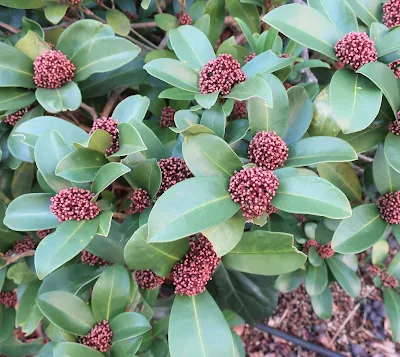
These are the flower buds of skimmia japonica or more commonly known as Japanese skimmia. These buds open to tiny fragrant white flowers in March to May, but the leaves and fruits are toxic (containing alkaloids), and this is suggested in the name "skimmia." The term "skimmia" is derived from the Japanese words "ashiki mi," which means "bad fruit."

But the plant has another name "oku ryou" in Japan, meaning 100,000,000 ryou because the fruits are bigger than those of ardisia crenata (Christmas berry), which is called "man ryou" or "10,000 ryou." Ryou is a unit of weight and currency used in Japan and other Asian countries.   

Skimmia japonica 深山樒

Japanese skimmia ミヤマシキミ

Edgeworthia Chrysantha (Oriental Paperbush) 三椏(ミツマタ)

Japanese follows English. 英語の後に日本語が続きます。

These are the flower buds of edgeworthia chrysantha or more commonly known as oriental paperbush. The plant is a kigo for early spring. Kigo is a word or phrase associated with a particular season used in traditional forms of Japanese poetry, such as haiku. So for me, oriental paperbush buds always herald the arrival of spring (although it's coldest in January and February in Japan). 

The plant is used to make Japanese paper and bank notes. Because of its importance, oriental paperbush is depreciated over five years as a depreciable asset under Japanese corporate tax law😊.  

Edgeworthia chrysantha 三椏

Ardisia Crenata (Christmas Berry) 万両(マンリョウ)

Japanese follows English. 英語の後に日本語が続きます。

These are the berries of ardisia crenata or more commonly known as Christmas berry at Atago Jinja shrine in Tokyo. Last December I found beautiful white coral berry (i.e., ardisia crenata f. leucocarpa) in my neighborhood. So this year, I really want to find YELLOW berry ardisia crenata (i.e., ardisia crenata f. xanthocarpa)😊!

Ardisia crenata 万両

Christmas berry マンリョウ

Hie Shrine 赤坂日枝神社

英語の後に日本語が続きます。 This is Hie Shrine in Akasaka , Tokyo. Although the tunnel of vermilion torii gates is much shorter than the ones at Fushimi ...