英語の後に日本語が続きます。
Lilies are native to Asia, Europe, and North America. There are more than 100 wild species around the world and 15 in Japan, producing flowers in various colors from May to August in Japan, of which I've seen pale pink, yellow (scroll down), red (Blackout red), and orange (Thunberg orange). The lily bulb (mainly the Maximowicz's lily's [Lilium leichtlinii]) is edible, often steamed, sauteed or deep-fried (i.e., tempura), as a seasonal delicacy in Japan. So, if you have a chance to come to Japan in winter, don't miss eating lily bulb or "yurine" TEMPURA to enjoy its soft and fluffy texture.
Hi! I'm Kei Narujima. This is a blog about flowers, plants, and bugs I saw in CENTRAL Tokyo, and sometimes art and Japanese culture that bring you a smile or make you think (or so I hope)!! こんにちは。花や虫、そして時々日本の文化などについて書いてます😊。
Orange Lily - A Stamen Consists of Filament and Another 百合の雄しべ
Japanese follows English. 英語の後に日本語が続きます。
A stamen consists of a stalk called "filament" and the tip part called "another." Umm, is "another" the name of the tip part of a stamen? Please someone, give a better name to this beautiful brown parts!!
I like parts of a flower, i.e., pistil, style, stamen... Their shapes and points where they are attached vary between flowers. Their detailedness is amazing, which makes each flower unique! And that's why I love the orange lily below. Look at its long stamens!
| Stamens of lily are long and conspicuous! ユリの雄しべは長い!目立つ! |
A stamen consists of a stalk called "filament" and the tip part called "another." Umm, is "another" the name of the tip part of a stamen? Please someone, give a better name to this beautiful brown parts!!
(If you wish to post your comment but don't have a Google account, select "anonymous" from the drop down menu titled "comment as"!)
ユリです。でも今日の主役は雄しべ。すごい存在感です。葯と花糸から構成されています。ちなみに葯って「another」って言うそうです。「another」? なんておざなりな。。。 誰かもうちょっといい名前を付けてあげて~😃
(Google アカウントを持ってない方は、コメント記入後に「Google アカウント」をクリックし、「匿名」か「名前/URL」を選択してからご記入ください!)
ユリです。でも今日の主役は雄しべ。すごい存在感です。葯と花糸から構成されています。ちなみに葯って「another」って言うそうです。「another」? なんておざなりな。。。 誰かもうちょっといい名前を付けてあげて~😃
(Google アカウントを持ってない方は、コメント記入後に「Google アカウント」をクリックし、「匿名」か「名前/URL」を選択してからご記入ください!)
It's Not Sweet Pepper But... しし唐じゃありません
Japanese follows English. 英語の後に日本語が続きます。
These are neither sweet peppers nor any other green peppers, but lily fruits😉!!
More specifically, they are fruits of lilium maculatum Thunberg below. Can you imagine such bright orange lilies ending like these cute shaped fruits??? I just couldn't believe my eyes, so checked the flower tag again and again, but it said "Lilium maculatum Thunberg.".....
People say that "the first impression is important," and this is especially true of Thunberg lilies. I wouldn't have stopped there if I hadn't seen these conspicuous flowers in bloom before in the same place!
「何これ?、しし唐?」
「えー、ここ、スカシユリが咲いていたとこじゃん」
「えー!! これスカシユリの実!!!?」
と、こういう風に私の心中は激しく揺れ動いたのです。ホントびっくりしました😲。
(Google アカウントを持ってない方は、コメント記入後に「Google アカウント」をクリックし、「匿名」か「名前/URL」を選択してからご記入ください!)
These are neither sweet peppers nor any other green peppers, but lily fruits😉!!
| It's not a sweet green pepper しし唐じゃありません |
| What do you think it is??? 何でしょう? |
| Fruits of something (see photo below) 何かの実(下の写真をご覧ください) |
| Lilium maculatum Thunberg! スカシユリ! |
(If you wish to post your comment but don't have a Google account, select "anonymous" from the drop down menu titled "comment as"!)
「何これ?、しし唐?」
「えー、ここ、スカシユリが咲いていたとこじゃん」
「えー!! これスカシユリの実!!!?」
と、こういう風に私の心中は激しく揺れ動いたのです。ホントびっくりしました😲。
(Google アカウントを持ってない方は、コメント記入後に「Google アカウント」をクリックし、「匿名」か「名前/URL」を選択してからご記入ください!)
Lilium Maculatum Thunberg スカシユリ
英語の後に日本語が続きます。
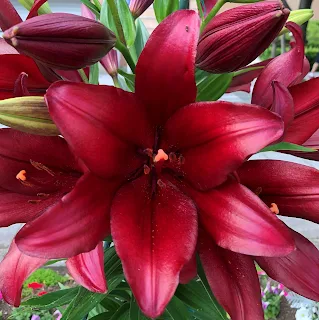
Blackout lily's red (click here to read "Asiatic 'Black Out' Lilly") is so powerful, but the orange of the lily below is as powerful as that red, isn't it?
This is Lilium maculatum Thunberg or in Japanese "see-through lily" because of openings between petals, through which it's said people can see things. So I carefully observed the lily to see if I could really see through between the petals, but I couldn't. I didn't find any gaps between them🙄.....
By the way, this color orange and Blackout's red reminded me of sweaters I bought last year. I used to prefer dull colors, but am getting more interested in brighter colors like these orange and red lilies (or sweaters). As a result I have worn almost every color, i.e., white, yellow, beige, orange, red, pink, purple, blue, navy, green, black, brown, gray.....
I've been intrigued by colors and that's why I admire late Mr. Sachio Yoshioka, a Japanese natural dyer and textile historian. When I feel sad or need something to cheer me up, I often read one of his books, "Dictionary of colors in Japan (Nihon [or Nippon] no iro jiten)," listing shades of colors according to Japanese color classification.
![]() |
| 2020/6/7 |
Asiatic 'Black Out' Lilly 赤い百合「ブラックアウト」
Japanese follows English. 英語の後に日本語が続きます。
This is Asiatic lily "Blackout."
Why is it "Black out"? I googled, but couldn't find the reason. Is it because the flower is so beautiful that someone looking at it may lose consciousness? Or when someone blacks out, do they often see something red like this flower?
![]() |
| Asiatic Black Out Lilies ブラックアウト |
![]() |
| Why "Black out"? 名前の由来は分かりませんでした。。。 |
Why is it "Black out"? I googled, but couldn't find the reason. Is it because the flower is so beautiful that someone looking at it may lose consciousness? Or when someone blacks out, do they often see something red like this flower?
Anyway, the name "Black out" matches this dark carmine red lily so much!
(If you wish to post your comment but don't have a Google account, select "anonymous" from the drop down menu titled "comment as"!)
最初、一瞬後ずさり。自然のものとは思えない赤。いやいや、花だから自然か。。。 なんて思いつつ、写真を撮りました。
「ブラックアウト」という百合です。名前の由来を調べましたが分かりませんでした。あまりにきれいでみんな気を失う(ブラックアウトする)からでしょうか。
理由は分かりませんが、ぴったりな名前だと思いました😄
(Google アカウントを持ってない方は、コメント記入後に「Google アカウント」をクリックし、「匿名」か「名前/URL」を選択してからご記入ください!)
Lily of the Incas, Foxgloves, and Osaka Auntie! アルストロメリアとジギタリスはヒョウ柄だ!
Japanese follows English. 英語の後に日本語が続きます。
Flowers with leopard spots attracted my attention, making me stop and stare at them.
I first thought that they were azaleas, but something was different, so at home I googled and learned that they are lilies of the Incas. Then a few days later, I found flowers which also have leopard spots on their petals.
These two tall flowers are foxgloves. Lilies of the Incas and foxgloves are both conspicuous for their leopard spots, and such spots reminded me of lovely women called Osaka Auntie!
Osaka Auntie is a literal translation of "Osaka no obachan," meaning middle-aged women in Osaka, the second largest city after Tokyo in Japan.
Osaka is different from Tokyo in many ways. As the city called the "kitchen of Japan," Osaka is known for a variety of delicious food where people prefer dashi to soy sauce. Also, Osaka people are more talkative and open, and less reluctant to bargain over prices. And middle-aged women there, Osaka Aunties, are famous (or notorious!) for being too chatty, obliging and a little pushy😁, and loving leopard print clothing!!
I'm not interested in leopard print clothing, but I admire Osaka Aunties for their straightforward and caring nature....
In Japanese, lily of the Incas is "lily daffodil" while foxglove just "foxglove," a translation of the English name.
Flowers with leopard spots attracted my attention, making me stop and stare at them.
![]() |
| A flower with leopard spots ヒョウ柄のツツジ? |
![]() |
| Lilies of the Incas 百合水仙 |
I first thought that they were azaleas, but something was different, so at home I googled and learned that they are lilies of the Incas. Then a few days later, I found flowers which also have leopard spots on their petals.
![]() |
| Leopard spots on petals ヒョウ柄 |
![]() |
| Foxglove ジギタリス |
These two tall flowers are foxgloves. Lilies of the Incas and foxgloves are both conspicuous for their leopard spots, and such spots reminded me of lovely women called Osaka Auntie!
Osaka Auntie is a literal translation of "Osaka no obachan," meaning middle-aged women in Osaka, the second largest city after Tokyo in Japan.
Osaka is different from Tokyo in many ways. As the city called the "kitchen of Japan," Osaka is known for a variety of delicious food where people prefer dashi to soy sauce. Also, Osaka people are more talkative and open, and less reluctant to bargain over prices. And middle-aged women there, Osaka Aunties, are famous (or notorious!) for being too chatty, obliging and a little pushy😁, and loving leopard print clothing!!
I'm not interested in leopard print clothing, but I admire Osaka Aunties for their straightforward and caring nature....
In Japanese, lily of the Incas is "lily daffodil" while foxglove just "foxglove," a translation of the English name.
(If you wish to post your comment but don't have a Google account, select "anonymous" from the drop down menu titled "comment as"!)
1枚目は「ツツジかな。。。」と思いながら「いや違う」の繰り返しが続いていた花です。ふとしたことがきっかけで、アルストロメリア(またはインカの百合)だということが分かりました。2枚目と3枚目はジギタリスです。
目を奪われたのはその紋様、ヒョウ柄です!いつか京都に住みたいと思っていますが、気持ちは「大阪のおばちゃん」のように元気で明るく、物おじしない女性になりたい!(ヒョウ柄は着ませんが。。。)。いや既にそうなのかもしれません🙇
アルストロメリアの和名は「百合水仙」、ジギタリスは「狐の手袋」です。
目を奪われたのはその紋様、ヒョウ柄です!いつか京都に住みたいと思っていますが、気持ちは「大阪のおばちゃん」のように元気で明るく、物おじしない女性になりたい!(ヒョウ柄は着ませんが。。。)。いや既にそうなのかもしれません🙇
アルストロメリアの和名は「百合水仙」、ジギタリスは「狐の手袋」です。
(Google アカウントを持ってない方は、コメント記入後に「Google アカウント」をクリックし、「匿名」か「名前/URL」を選択してからご記入ください!)
登録:
投稿 (Atom)
Grasshopper (Atractomorpha) オンブバッタ(負飛蝗)
英語の後に日本語が続きます。 These are grasshoppers. Plan and simple. The twist, however, is their relationship. A man passing by while I was taking these...
-
英語の後に日本語が続きます。 This is the best shot I could get. It's a female Joro spider, I think. I noticed her spider web first several months ago ...
-
英語の後に日本語が続きます。 I often mistake horseflies for bees, but I believe this is a bee, maybe a bumblebee!!?? If so, it's my first time to see ...