ラベル Mushroom(キノコ) の投稿を表示しています。 すべての投稿を表示

Deceiver (Laccaria Laccata) キツネタケ(狐茸)

英語の後に日本語が続きます。

It's been raining on and off in Tokyo for the past month. I recently found these mushrooms, which appear to be deceivers. They weren't there the day before. Deceivers are edible and can be found around the world. In Japan, the mushroom is called "kitsunetake," which translates to "fox mushroom," due to its color.  

2026/9/24

2026/9/24

Orange Bracket Fungus (Pycnoporus Coccineus) ヒイロタケ(緋色茸)

英語の後に日本語が続きます。

Orange bracket fungus (Pycnoporus coccineus) can be found in east Asia, Australia, North and South Americas, and Africa, so across Japan but Hokkaido. The mushroom is not inedible but too hard to eat. The bright orange bracket fungus is used to create natural textile dyes in Japan.

2026/9/13

False Parasol (Chlorophyllum Molybdites) オオシロカラカサタケ(大白唐傘茸)

英語の後に日本語が続きます。

The false parasol mushroom (Chlorophyllum molybdites) is native to temperate and subtropical regions but can now be found across Japan. The mushroom is beautiful and looks delicious but has poisoned many people...😱 As nicknamed the " vomiter," the mushroom is poisonous, causing literally vomiting and diarrhea! 

2026/9/2

Antilles Mottlegill (Panaeolus Antillarum) ツヤマグソタケ(艶馬糞茸)

英語の後に日本語が続きます。

It was great fun finding mushrooms that hadn't existed a few days earlier. They've just popped up for the past couple of days, during which it rained heavily due to a typhoon. Google Lens identifies them as antilles mottlegill (Panaeolus antillarum) but I'm not sure. 

Many mushrooms are safe to touch and eat (and tasty!) but some are not. In Japan, 30 to 70 people are treated for mushroom poisoning every year. The Japanese ministry of agriculture, forestry, and fishery has a website on 10 most typical poisonous mushrooms in Japan (in Japanese only).   

2026/6/30

Mushrooms キノコ

英語の後に日本語が続きます。

It was amazing to find not one or two but five types of mushrooms just in a day. These mushrooms hadn't existed a few days earlier, so it means that they've just popped up for the past couple of days, during which it had rained. They resemble edible mushrooms, such as shiitake (1st and 2nd photos) and shimeji (last two photos) and that's why the ministry of agriculture, forestry, and fishery has a website on poisonous mushrooms in Japan (in Japanese only).   


Plantpot dapperling (Leucocoprinus birnbaumii) コガネキヌカラカサタケ (黄金絹唐傘茸)

英語の後に日本語が続きます。

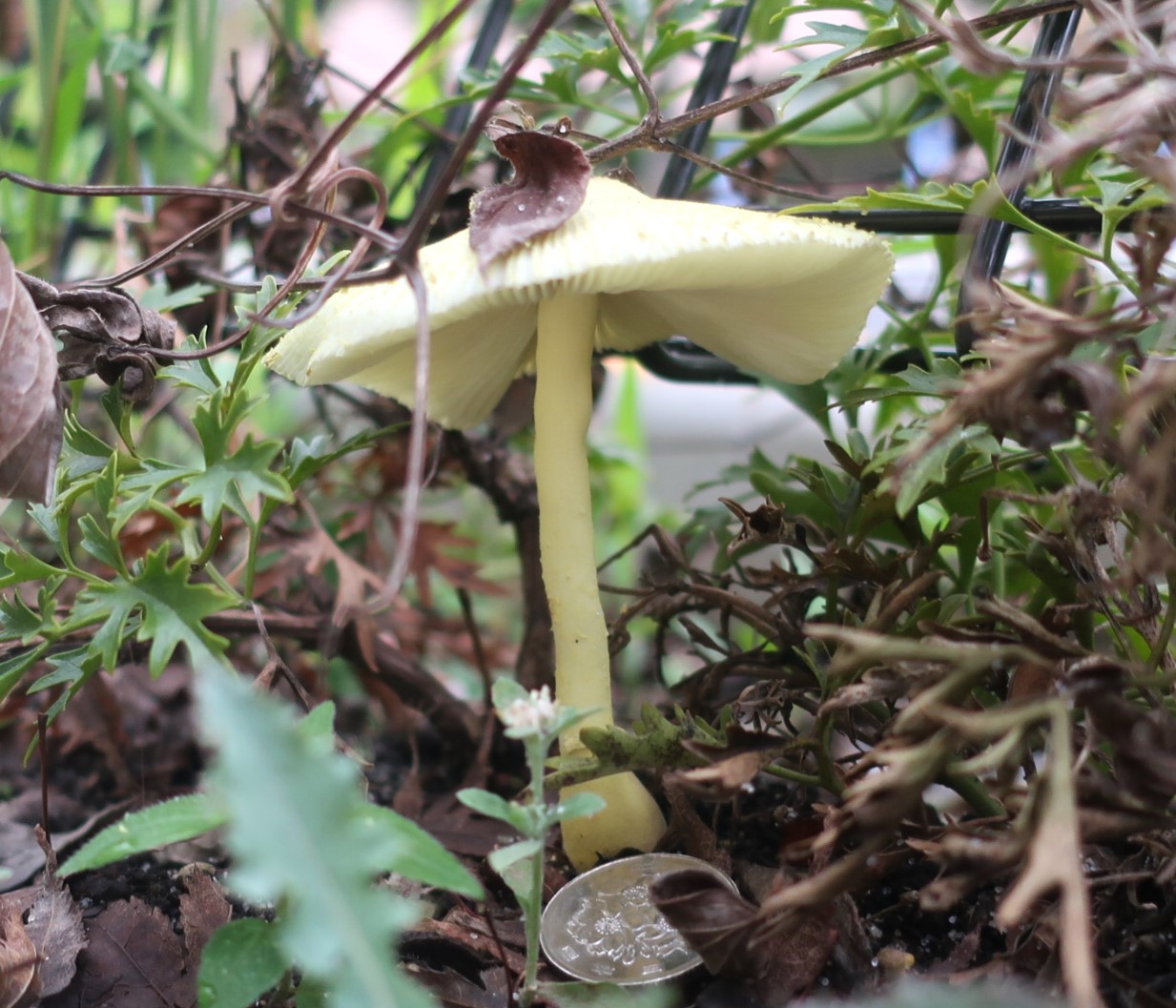
The weather is very hot, humid and unstable this summer in Japan. Torrential rain fell last night in Tokyo, causing flooding in some areas and affecting the public transportation system. Well, rain, especially heavy rain, does no good to people living in cities, but for mushrooms, rain is a blessing. These are (I believe) plantpot dapperling (Leucocoprinus birnbaumii).

They're beautiful cream yellow (see the 2nd and 3rd photos) and pretty big, like 8cm in diameter (see the 1st photo to compare with a 100 yen coin with 22.6mm in diameter). The mushroom lives only for 1 to 3 days, so they should be gone tomorrow. 

Plantpot dapperling (Leucocoprinus birnbaumii) コガネキヌカラカサタケ (黄金絹唐傘茸)

Another smaller one 2個目は少し小さ目

Coprinopsis Lagopus (Hare’s Foot Inkcap)? 粗柄一夜茸(ザラエノヒトヨタケ)?

英語の後に日本語が続きます。

This is a hare’s foot inkcap mushroom (Coprinopsis lagopus) or so I think. It started to dry, but it was still beautiful. When I was taking these photos, a dog approached me, starting to bark. Feeling I needed to say something, I said to the owner that I'd found a mushroom. He was surprised that a mushroom grew in a park. Few know that many wild plants and (not many but some) mushrooms grow in Central Tokyo.  

Hare’s foot inkcap (Coprinopsis lagopus)? ザラエノヒトヨタケ(粗柄一夜茸)?

Coprinopsis Lagopus (Hare’s Foot Inkcap)? 粗柄一夜茸(ザラエノヒトヨタケ)?

Japanese follows English. 英語の後に日本語が続きます。

It's less hot but still humid in Japan and that's why I found them. These are hare’s foot inkcap mushrooms (Coprinopsis lagopus) or so I think. Mushrooms usually attract me for their shape but hare’s foot inkcap mushrooms intrigue me with their color, i.e., translucency.

Hare’s foot inkcap 粗柄一夜茸

Coprinopsis lagopus ザラエノヒトヨタケ

Coprinopsis Lagopus (Hare’s Foot Inkcap)? 粗柄一夜茸(ザラエノヒトヨタケ)?

Japanese follows English. 英語の後に日本語が続きます。

These are Coprinopsis lagopus or more commonly known as hare’s foot inkcap mushrooms (or I think so😉). At first, I didn't notice them as when finding them, I was looking for colorful flowers, but something caught my eye and I turned around and found these translucent mushrooms. Mushrooms usually attract me for their shape but hare’s foot inkcap mushrooms intrigue me with their color, i.e., translucency. 

Coprinopsis lagopus? 粗柄一夜茸?

Hare’s foot inkcap mushroom? ザラエノヒトヨタケ?

Polyporaceae 猿の腰掛(サルノコシカケ)

Japanese follows English. 英語の後に日本語が続きます。

This looks like a pancake, but it's not. This is polyporaceae on a cherry tree, a mushroom called "a stool for monkeys🐒" in Japan.  

I read about birch polypore on @zaungruen's Instagram post several days ago, in which Zaungruen said that he/she has birch polypore tea for colds. As a person taking Chinese herbal medicine to deal with dyspepsia (which is very effective for me), I'm very interested in polyporaceae's efficacy, and learned that in Japan, the mushroom is said to lower blood pressure and boost the immune system, while it's also said to decay and even kill trees by absorbing nutrients from them! A person can be good and bad at the same time. A mushroom can also be good and bad at the same time.          

Polyporaceae 猿の腰掛

Pancake or Mushroom? パンケーキ?キノコ?

英語の後に日本語が続きます。

This is a pancake I found on the ground. 😁 Oops, sorry! It's actually a mushroom—likely a suede bolete (Xerocomus subtomentosus). While it's edible, it's not supposed to be very tasty. You should probably leave it behind anyway, as it could be Neoboletus venenatus, a toxic lookalike.

I saw the mushroom at Mukojima-Hyakkaen Garden. The garden was built at the beginning of the 19th century by Sahara Kikuu, an antique dealer, and has over 230 species of plants—including Japanese bush clover, which comes into full bloom in late September. It’s not very large, about 10,885 square meters, but it has a natural, rustic charm with plenty of wild plants and flowers.

A pancake with melted butter and maple syrup? バターとメープルシロップたっぷりパンケーキ?

Sasanqua Camellia 'Hana Jiman' 花自慢

英語の後に日本語が続きます。 Sasanqua camellia (Camellia sasanqua) is native to Japan and can be found throughout the country. It produces white, pink, an...