ラベル Sky/Clouds(空と雲) の投稿を表示しています。 すべての投稿を表示

Hamilton's Spindletree (Euonymus Hamiltonianus) マユミ(檀)

英語の後に日本語が続きます。

Some plants bring you happiness through the year and Hamilton's spindletree (Euonymus hamiltonianus) is one of them. The plant is native to East Asia and can be found across Japan. It produces tiny cream flowers from May to June and fruits in autumn. The fruits are four-lobed and green at the beginning, then turn pale pink, and crack to show seeds with red arils in autumn.

A good thing about photographing plants is to make people more talkative. When I was photographing the fruits in September, two women approached me asking what they were. I said they were the fruits of Hamilton's spindletree but the women insisted they couldn't be fruits but buds to flower soon. It was fun talking with strangers about little things.

2026/4/24

2025/5/9

Ginkgo (Ginkgo Biloba) イチョウ(銀杏)

英語の後に日本語が続きます。

Ginkgo (Ginkgo biloba) is native to China but can now be found across Japan. The tree, a gymnosperm plant, has male and female trees. The male trees have catkin like male flowers from April to May, which produce pollen, while the female trees have female flowers also from April to May and fruits from September to November. 

2024/11/30

2025/11/1

Kawazu Cherry (Cerasus x Kanzakura 'Kawazu-Zakura') カワヅサクラ(河津桜)

英語の後に日本語が続きます。

Kawazu cherry is a crossbreed of Oshima cherry (Prunus speciosa) and Taiwan cherry (Prunus campanulata) and named in 1972 after the Kawazu town, Shizuoka prefecture (Source: Kawazu town tourist association). Kawazu cherry trees bloom from early February to March, a little earlier than other cherry trees. A Kawazu cherry blossoms festival is held in the town every February.

Japanese Cornel (Cornus Officinalis) サンシュユ(山茱萸)

英語の後に日本語が続きます。

The Japanese cornel (Cornus officinalis) is native to China, Korea, and Japan and can be found across Japan. The tree produces umbels of bright yellow flowers from March to April and berries that get redder from October to November. 

The bright yellow of Japanese cornel flowers is called a "vitamin color" in Japan because it's said to energize people, which I believe is true. In spring, many stop in front of the trees to look at their pretty flowers talking about the joy of spring but surprisingly and sadly, most don't know the Japanese cornel. The Japanese cornel is one of the most underestimated trees because of their blossoming at almost the same time as cherry and Japanese apricot trees.    

2026/3/11

2026/3/11

Oshima Cherry Blossoms (Prunus Speciosa) 大島桜(オオシマザクラ)

英語の後に日本語が続きます。

There are a variety of cherry blossoms and the king of them is Somei Yoshino, but Oshima cherry blossoms (Prunus speciosa) are not bad, i.e., as beautiful as, and more gorgeous than, Somei Yoshino cherry blossoms, aren't they? 

Unlike Somei Yoshino cherry blossoms, which are pinkish white, Oshima cherry blossoms are whitish pink at first, then turn to baby pink. Another difference between Oshima and Somei Yoshino is that Oshima cherry trees produce blossoms and leaves at the same time (as you can see in these photos) while Somei Yoshino produces blossoms first and then leaves after blossoms fall. 

2025/3/27

2025/3/30  Oshima cherry blossoms are white at first 最初はこんな感じ

2023/3/20 They're also Oshima cherry

Maple Leaves in Autumn もみじの紅葉

英語の後に日本語が続きます。

Some leaves are still green but that makes the perfect color gradients from green to yellow, orange and red. Autumn leaves are beautiful but more beautiful against the blue sky.  

2024/12/14

2024/12/27

2024/12/27

Tokyo Skytree against Sky at Night 夜の東京スカイツリー

英語の後に日本語が続きます。

I took this photo to keep a memory of such a beautiful view. The night view included various colors. 

Tokyo Skytree against sky at night 夜の東京スカイツリー

Flowering Quince (Chaenomeles Speciosa) ボケ(木瓜)

Japanese follows English. 英語の後に日本語が続きます。

It snowed heavily in Tokyo last weekend, so I didn't go out. Then yesterday, while taking an early morning walk, I found flowering quince (Chaenomeles speciosa) starting to produce buds. The temperature was 2°C, still low for Tokyo, but the bright red buds made me feel a little warm. 

Flowering quince (Chaenomeles speciosa) ボケ(木瓜)

Blue Sky After Snowfall 雪の後の青空

英語の後に日本語が続きます。

It snowed heavily in Tokyo yesterday and the day before (I mean heavily for Tokyo!), so I didn't go out for the two days. This morning, the temperature was 2°C (which is very low for Tokyo) and the air was cold but the winter cherry blossoms, which have survived the snow, were so beautiful against the clear blue sky.  

Winter cherry against blue sky 青空と冬桜


The Moon in the Blue Sky 月と青空

Japanese follows English. 英語の後に日本語が続きます。

It was around 7 a.m. I looked up in the sky and saw the Moon. The air is cold and dry. It's a typical Japanese winter day.  

The Moon in the sky 月と青空

Sunset 夕焼け

Japanese follows English. 英語の後に日本語が続きます。

I'm an early bird, so I see the sunrise almost everyday but rarely see such a beautiful sunset. I was just standing there smiling. 

Sunset 夕焼け

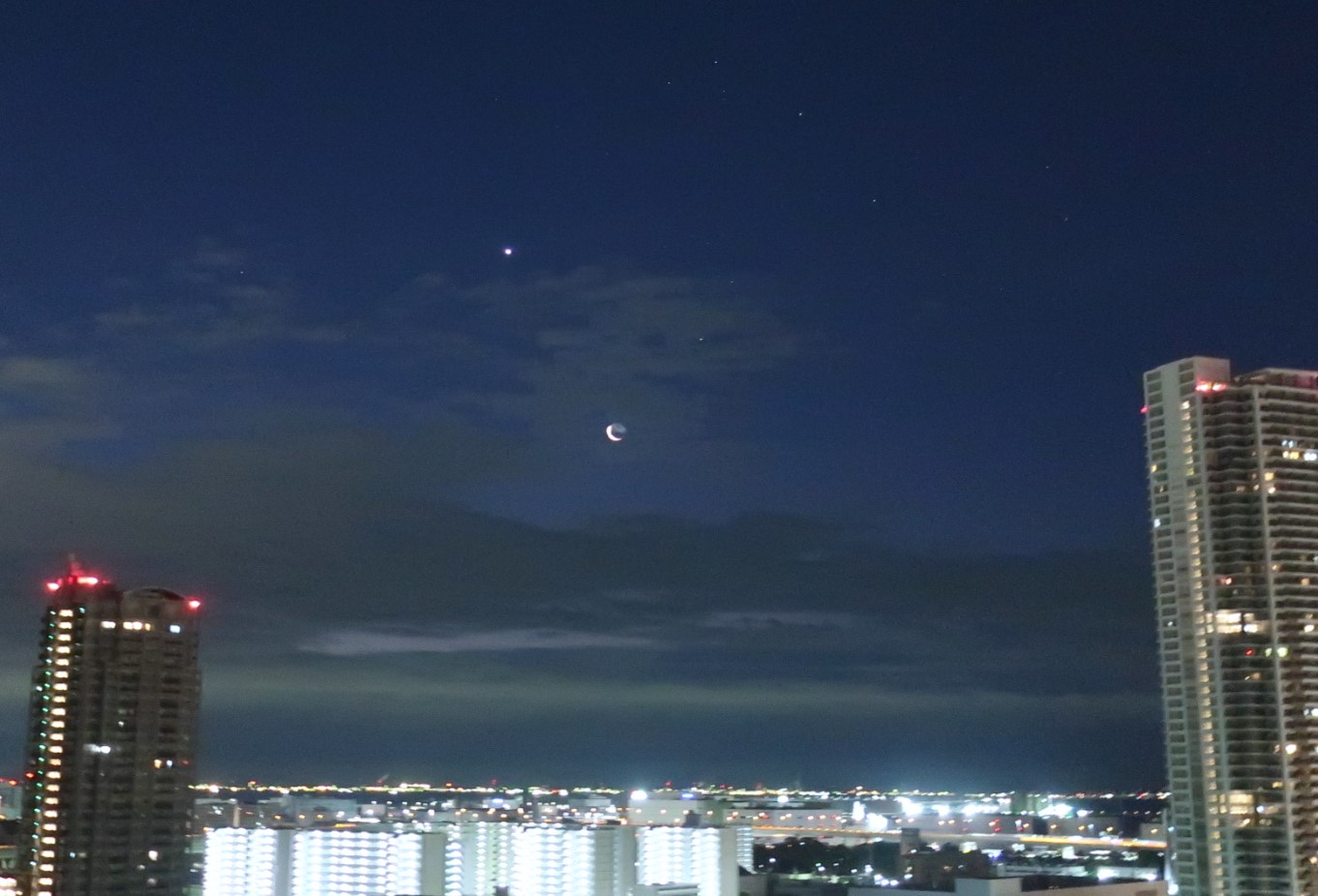
Venus and Crescent Moon 月と金星

Japanese follows English. 英語の後に日本語が続きます。

Can you see them? If not, look at the second photo. They are the crescent moon and bright Venus.


Venus and the crescent moon

Autumn Leaves and Blue Sky 紅葉と青空

Japanese follows English. 英語の後に日本語が続きます。

I went somewhere and found them. It was a very sunny day. These autumn leaves were so red against the background of the blue sky.   

A Reflection of The Tokyo Tower 東京タワー

Japanese follows English. 英語の後に日本語が続きます。

This is a reflection of The Tokyo Tower on a nearby building. The tower itself is beautiful at night (unlike the tower during the day), but I found its reflection more beautiful. Which do you like better? 

The Tokyo Tower 東京タワー

A Rainbow View from Nigatsudo, Todaiji Temple 東大寺二月堂から見た虹

Japanese follows English. 英語の後に日本語が続きます。

This is a view from the balcony of Nigatsudo or the February Hall of Todaiji temple in Nara. You can also see the Nara city over there. That day, I woke up at around 4 a.m. (as usual) and decided to walk to the temple to see the sunrise. Unfortunately, the sunrise wasn't visible from there, but instead I saw this rainbow🌈!

If you have a chance to come to Nara, I recommend visiting the temple in the early morning. You may have this view (and the Great South Gate) all to yourself.  

A rainbow from the February Hall of Todaiji temple 二月堂から見た虹

Kofukuji Temple and Sarusawa Pond 興福寺と猿沢池

Japanese follows English. 英語の後に日本語が続きます。

These are photos of Sarusawa pond and Kofukuji temple in the Nara prefecture, Japan at sunrise (1st photo) and sunset (2nd photo). The five storied pagoda (last photo) of the temple is currently undergoing large-scale repairs, so I gave up on seeing it but I was able to see the pagoda in a nearly perfect form (although the first story was covered by a fence).

Kofukuji temple is one of Japan’s oldest and most famous Buddhist temples with a history of more than 1,300 years and I definitely recommend visiting the temple, especially to see the pagoda, which the temple once auctioned for 25 yen then or 100,000 yen (930 US dollars) currently😲. If you're interested in why the temple did such a stupid thing, read this post!  

Sarusawa pond at sunrise 日の出の猿沢池

Sarusawa pond and 5-story pagoda of Kofukuji temple at sunset
日の入りの猿沢池と興福寺五重塔

Sweet Autumn Clematis and the Winter Moon 仙人草と冬の月

Japanese follows English. 英語の後に日本語が続きます。

Clematis terniflora or sweet autumn clematis are still in bloom. Clematis generally flowers from July to September and I saw the achenes surrounded by feather like white long tails in early November (after which its Japanese name is given). So, maybe I was lucky to be able to see the flowers and the winter Moon at the same time!

Clematis terniflora (sweet autumn clematis) 仙人草

Yuki Tsuri - Japanese Way to Protect Trees from Snow 雪吊り(ゆきつり)

Japanese follows English. 英語の後に日本語が続きます。

These cone shaped things are "yuki tsuri" at the Hama Rikyu Garden. Yuki tsuri is a Japanese technique to protect trees from heavy snow with straw ropes that are attached to the ends of the tree's longer branches. The technique is commonly seen in the Hokuriku region where it heavily snows, such as Kanazawa city, while in Tokyo where it rarely snows, yuki tsuri functions more as a seasonal decoration. The yuki tsuri, the blue sky and the skyscrapers created a surreal contrast. 

The Hama Rikyu Garden, about 62 acres, was built by Tsunashige Tokugawa in 1654 on reclaimed land from Tokyo Bay. The garden was transferred to the Imperial Household Agency in 1870, then to Tokyo in 1945 and opened as a public garden in the following year. You can always enjoy some flowers/plants from cherry blossoms to autumn foliage in the garden.

Yuki tsuri to protect trees from snow 雪吊り

Tokyo Skytree & Yakatabune Boat 東京夜景

Japanese follows English. 英語の後に日本語が続きます。

These are the views I saw from the Tsukuda Ohashi Bridge in Tokyo on November 6. I was on my way back home from one of my favorite restaurants in Central Tokyo. The restaurant offers soba, i.e., Japanese noodles made from buckwheat flour, and it had been a year since I had last gone there.

On September 30, Tokyo lifted the state of emergency and has seen a decrease in Covid-19 cases since then, and that's why I decided to go to that restaurant for the first time in the last year. The dinner was delicious and the Sumidagawa River (1st photo), Tokyo Skytree and the Chuo Ohashi Bridge (both 2nd photo) were all beautiful but I couldn't help but feel sad because I saw only one yakatabune boat (1st photo). The boat cruise was popular before the pandemic with many boats travelling upward and downward on the river, but the business has been severely hit since January 2020 when Covid-19 clusters were found among cruise passengers.

Japan has very few Covid-19 cases these days. Some say that that's because over 70% of people have been fully vaccinated and/or people wear face masks, or even mention the possibility of "apoptosis (i.e., a form of programmed death)" in coronavirus-infected cells. Vaccination and masks should contribute to decreasing coronavirus patients, but being too optimistic, i.e., believing in the programmed cell death despite still rising infections outside of Japan, is very stupid and dangerous.

A yakatabune boat on Sumidagawa River from Tsukuda Ohashi Bridge
隅田川を行く屋形船(佃大橋から)

Chuo Ohashi Bridge and Tokyo Skytree side by side 中央大橋とスカイツリー

Parliamentary Museum Has Azalea and Cherry 憲政記念館のツツジと桜

Japanese follows English. 英語の後に日本語が続きます。

I saw people coming out of a building across the street near the National Diet Building. I also saw trees with white flowers and green leaves inside the premises. Naturally I got closer to it, finding that that is the Parliamentary Museum.    

Miniature Japanese national diet building 国会議事堂ミニチュア

Purple Heart (Tradescantia Pallida) ムラサキゴテン(紫御殿)

英語の後に日本語が続きます。 Purple heart (Tradescantia pallida) is native to Mexico, came to Japan in around 1955, and can now be found across the countr...