Cogon Grass (Imperata Cylindrica) チガヤ(千萱)

英語の後に日本語が続きます。

(I believe that) they are cogon grass (Imperata cylindrica). The grass is native to tropical and subtropical regions of Asia, Australia, Micronesia, Melanesia, and parts of Africa and can be found across Japan. It produces fluffy, white seed spikes from May to June.

Cogon grass is one of the most invasive weeds with a plain appearance but has been deeply appreciated and utilized in Japan for a long time, even mentioned in Kojiki (i.e., an early Japanese chronicle of myths, legends, hymns, genealogies, oral traditions, and semi-historical accounts, composed in the early 8th century) and Man'yōshū (i.e., the oldest extant collection of waka or poetry in Classical Japanese, compiled at the end of the Nara period [710-794]). The plant was also eaten in Japan after the war.

The flower means "affectionate," "guardian deity of children," and "we all want to be together" in Japanese floriography. 

2026/5/19

2026/5/19

Various Lacecap Hydrangeas 額紫陽花(ガクアジサイ)いろいろ

英語の後に日本語が続きます。

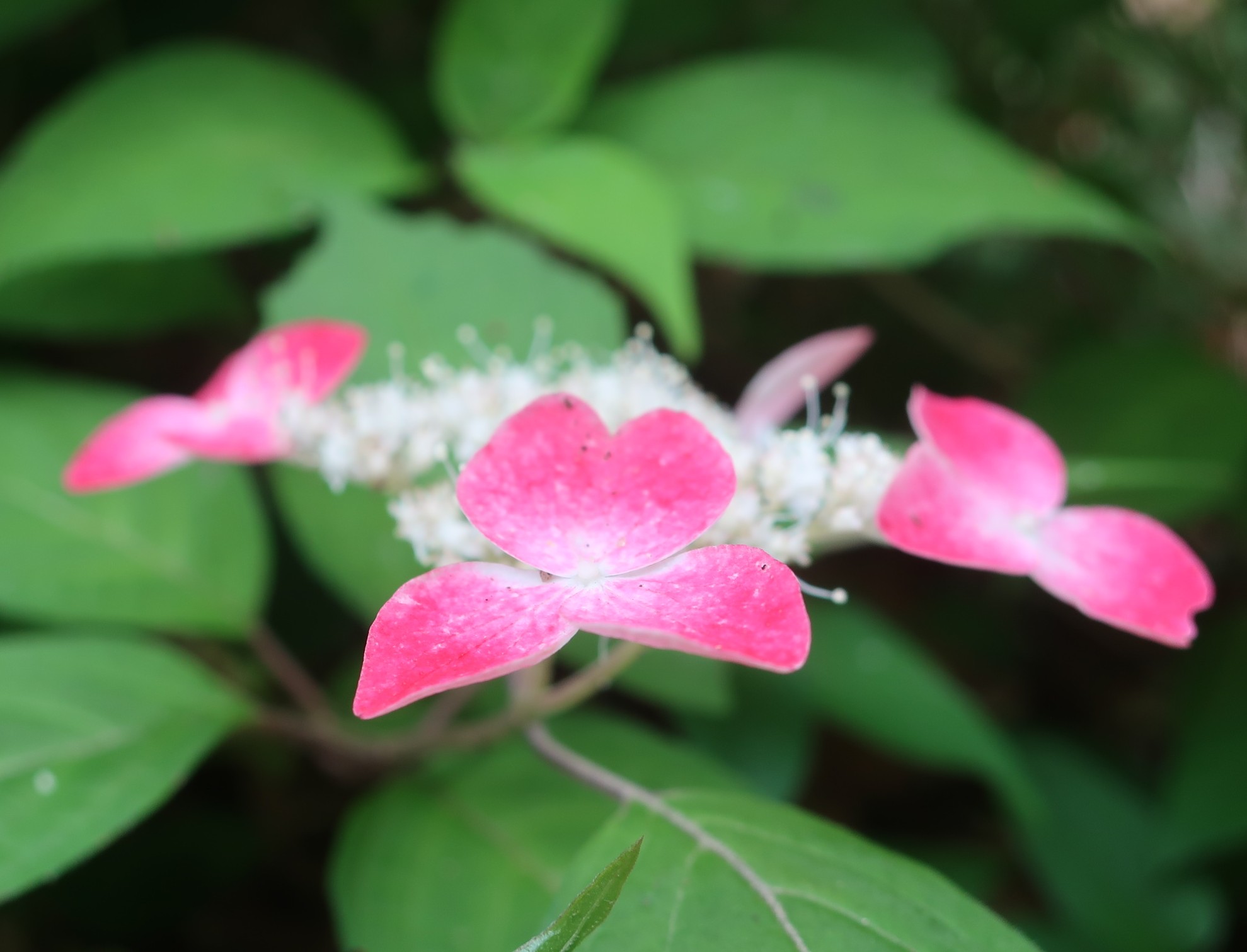
It's almost impossible to classify lacecap hydrangeas (Hydrangea macrophylla f. normalis) based on color. Each one has cream, yellow, blue, purple, green, pink, and red fertile flowers surrounded by green, pink, blue, purple, red, and even white sterile decorative sepals, changing their gradients as time passes. It's reasonable that one of its Japanese names is "shichi henge," which translates into "seven changes." To see lacecap hydrangeas in pink or purple, read this post

2020/6/3

2020/6/3

Love-In-A-Mist (Nigella Damascena) ニゲラ(黒種草)

英語の後に日本語が続きます。

Love-in-a-mist (Nigella damascena) is native to the Middle East, the Mediterranean, and Southwestern Asia. The plant produces blue, pink (scroll down), purple, white (scroll down), and yellow flowers from April to July, which are distinguished from other flowers by their many long stamens. What appear to be petals are actually sepals as in the case of hydrangeas. 

The plant is also called "devil-in-a-bush" and some may wonder why it can be "devil-in-a-bush" and "love-in-a-mist" at the same time. The Hutchinson News (the relevant article is gone) gave me an answer. "The plant, when green and flowering, is called love-in-a-mist, but when the horned seed pods dry in the autumn, it changes, like Jekyll and Hyde, to the name of devil-in-the-bush." 

This is also true of Carolina cranesbill, which also has good and evil within them. If you wanna see an angel and a devil within Carolina cranesbill or its Jekyll-to-Hyde change, read this!! 

2020/5/25

Pink/Purple Lacecap Hydrangea ピンク・紫のガクアジサイ(額紫陽花)

英語の後に日本語が続きます。

Hydrangeas are pleasing with their colors and these pink and purple mountain hydrangeas in particular because the blooms have not only beautiful sepals (sterile flowers) but also pretty petals (fertile flowers). The 4th photo is a close up of the center part consisting of real (fertile) flowers, which are so tiny and so beautiful!  To see lacecap hydrangeas in other colors, read this post

2026/5/14

2026/5/14

Annabelle Hydrangea (Hydrangea Arborescens 'Annabelle') アナベル

英語の後に日本語が続きます。

Annabelle hydrangea (Hydrangea arborescens 'Annabelle') is a cultivar of Hydrangea arborescens. The hydrangea is a late bloomer, producing flowers from May to July, which are lime green at first, turning white. Below are the shots of various hydrangeas. Hope you enjoy them!

Popcorn Hydrangea (Hydrangea Macrophylla Ayesha) ウズアジサイ(渦紫陽花)

英語の後に日本語が続きます。

They're one of my favorite hydrangeas, popcorn hydrangea (Hydrangea macrophylla Ayesha). Needless to say, the hydrangea is named after the shape of its sepals, which resembles that of popcorns.

2022/6/16  

2022/6/16  

Pomegranate (Punica Granatum) ザクロ(柘榴)

英語の後に日本語が続きます。

The pomegranate (Punica granatum) originated in the region spanning from the west to south Asia to the Middle East. It produces bright orange flowers in June and fruits that contain ruby-like edible seeds and pulp from September to October in Japan. 

The flowers always cheer me up with their bright orange while making me chuckle with their unique shape after petals fall off, which looks like an octopus sausage, i.e., a sausage cut to look like an octopus, often seen in children’s Bento lunches in Japan. BTW, octopuses have no legs but only arms.

If you've never seen a sculpture of a pomegranate fruit made of agate and ruby, read this post! You should be surprised by how real it looks!  

2025/6/8

2025/6/8

Chinese St. John's Wort (Hypericum Monogynum) ビヨウヤナギ(未央柳)

英語の後に日本語が続きます。

Chinese St. John's wort (Hypericum monogynum) is native to China, coming to Japan during the Edo period (1603-1868). It produces five petalled bright yellow flowers from June to July with incredibly long (also) bright yellow stamens where bees often bathe and dance.    

2026/5/19

MINI Pomegranate (Punica Granatum) ミニザクロ(ミニ柘榴)

英語の後に日本語が続きます。

The flowers are bright orange as the usual ones but are so mini as are the fruits (2nd photo)! They're MINI pomegranate (Punica granatum). 

2026/5/19

2024/8/3

Smiling Monkey Forest Tree (Magnolia Maudiae) ミヤマガンショウ(深山含笑)

英語の後に日本語が続きます。

Smiling monkey forest trees (Magnolia maudiae) are native to China but can be found in some places in Tokyo (although not as often as you would find Yulan magnolias). The smiling monkey forest tree produces white flowers from February to March in Tokyo. 

I did research about why the magnolia is called "smiling monkey forest tree" but couldn't find any good origin of the name. Interestingly, its Japanese name translates into "smiling flowers in deep mountains." Maybe everyone seeing the flower is reminded of someone's or monkeys' smiling face. 

2026/2/28

2026/2/28

Lithocarpus Edulis (Japanese Stone Oak) 馬刀葉椎(マテバシイ)

英語の後に日本語が続きます。

These are the nuts of lithocarpus edulis or more commonly the Japanese stone oak. The nuts are edible, tasting like chestnuts when baked (according to a website). I often picked the acorns when I was a child but I saw green acorns (2nd photo) for the first time.  

In Japan, the nuts of fagaceae trees are collectively called "donguri" and there's a famous song for children about an acorn falling into a pond "Donguri korokoro (i.e., Rolling acorn)."    

When these pale brown acorns turn dark brown, I hope the temperature and the number of Covid-19 patients will both become lower... 

2026/5/17

2021/8/31

Pink Wood Sorrel (Oxalis Articulata) イモカタバミ(芋酢漿草、芋片喰)

英語の後に日本語が続きます。

There are two types of pink wood sorrel, Oxalis articulata (those in this post) and Oxalis debilis. Both are native to South America but can now be found across Japan. 

The two are often confused but it's easy to tell which is which. Oxalis articulata is deeper pink and has a dark purple flower center and yellow anthers while Oxalis debilis is paler pink, having a pale yellowish green center and white anthers. Another big difference is in underground systems. Oxalis articulata has underground stems (i.e., rhizomes) like potatoes while Oxalis debilis grows from bulbils. This difference can be seen in Oxalis articulata's Japanese name "imo katabami," which translates into "potato wood sorrel," although poteto's underground stems are not rhizomes but tubers.

2026/5/18

Pink Wood Sorrel (Oxalis Debilis) ムラサキカタバミ(紫酢漿草)

英語の後に日本語が続きます。

Pink wood sorrel (Oxalis debilis) is native to South America, introduced to Japan during the Edo period (1603-1868) for aesthetic appeal. There are two types of pink wood sorrel, Oxalis debilis and Oxalis articulata. Both are pink but Oxalis debilis (those in this post) is a little bluish and paler. For a more detailed description of the differences between the two pink wood sorrel, read the post about Oxalis articulata.  

2026/5/17

St. John's Wort (Hypericum Perforatum) セイヨウオトギリソウ(西洋弟切草)

英語の後に日本語が続きます。

These are St. John's wort (Hypericum perforatum). The plant is native to Europe, west Asia, and northern Africa. It produces bright yellow flowers from June to August with long stamens as Chinese St. John's wort (Hypericum monogynum). They resemble each other but the flower size is different. The Chinese ones are bigger.  

St. John's wort (Hypericum perforatum) came to Japan after the late 1940s and before that Japan had another St. John's wort (Hypericum erectum) native to Asia. Therefore, Hypericum perforatum is called "western Hypericum erectum," which translates into "western plant killing younger brother" after a Japanese legend that a man got so angry at his younger brother, who'd leaked an important secret of a medicine made from St. John's wort, that he killed the brother😱. Because of this legend, in Japan, St. John's wort means "grudge" and "superstition." As the legend suggests, in Japan, the stems and leaves of Hypericum erectum were used as folk medicine to stop bleeding and for other medical purposes.   

Someone who can't keep their mouths shut ended up being killed in not only Japan but also in Italy. In an Italian short story "Mateo Falcone," a father kills his 10-year-old son because the son can't keep his mouth shut.

2022/6/30

2022/6/30

Japanese Bay Tree (Machilus Thunbergii) タブノキ(椨の木)

英語の後に日本語が続きます。

Beautiful green attracted my eye. These are fruits of the Japanese bay tree (Machilus thunbergii). The Japanese bay tree is native to East Asia and can be found across Japan. The fruits turn deep purple in summer, which, according to the internet, taste like avocado. This is understandable. The Japanese bay tree and avocado are both in the Lauraceae family. Japanese bay tree fruits are much smaller though, about 1 cm in diameter. 

2026/5/17

Kurogane Holly (Ilex Rotunda) 黒鉄黐(クロガネモチ)

英語の後に日本語が続きます。

Who can imagine the tree has such pretty flowers! They're flowers of Kurogane holly trees (Ilex rotunda), which are native to East Asia and can be found across Japan. I've seen the trees several times but only their fruits, which are also beautiful, and never expected them to produce such tiny beautiful flowers. After the flower season, Kurogane holly trees produce fruits (scroll down), which are green at first, turning orange, then red beautifully in autumn.  

2026/5/17

False Strawberry (Potentilla Hebiichigo Yonek. et H.Ohashi) ヘビイチゴ(蛇苺)

英語の後に日本語が続きます。

False strawberries (Potentilla hebiichigo Yonek. et H.Ohashi) are native to east to south Asia and can be found across Japan. False strawberries produce yellow flowers from April to June and berries at almost the same time. The berries are edible and look delicious, but tasteless and that's why in Japan they're called "hebiichigo" as contained in its scientific name, which translates into "snake strawberries" or "strawberries for snakes." 

False strawberries (Potentilla hebiichigo Yonek. et H.Ohashi) resemble another type of false strawberry (Potentilla indica) very much but there's a clear difference, i.e., the former's receptacle is white while the latter's is red and glossy. Both false strawberries produce yellow flowers from April to May in Japan (scroll down) but I was able to find them only once (2nd photo).   

2026/5/17

2026/5/14

Fish Mint (Houttuynia Cordata) ドクダミ

英語の後に日本語が続きます。

Fish mint (Houttuynia cordata) is invasive and smelly but its color contrast between the green yellow spike, the white bracts surrounding it, and the deep green leaves (whose edge is red) is so beautiful and always attracts me. 

I have a good memory of fish mint. My late maternal grandma, who ran a small Japanese green tea shop after her husband (i.e., my maternal grandpa) had died, often sent fish mint tea to me, who was suffering serious acne at that time. 

Fish mint tea is known for curing acne in Japan. It didn't taste good and I didn't like it, but I was so desperate that I drank the tea as many times as possible. My acne problem hadn't been cured until a skin doctor applied special treatment, but I'm pretty sure that the fish mint tea grandma gave me improved my skin condition!

Fish mint's English and Japanese names both don't describe its prettiness or medical efficacy, but even so, when passing by the flowers, I always feel warm and encouraged by Grandma, who lost her husband in her early 30s and after that raised her four daughters by herself, and maybe because of that, who was too busy to smile. Her favorite line was, "What's inside counts most!" When seeing fish mint I always ask myself what's inside of me.

2026/5/16

2022/5/20

Longstalk Holly (Ilex Pedunculosa) ソヨゴ(戦)

英語の後に日本語が続きます。

Longstalk holly (Ilex pedunculosa) is native to Asia and can be found across Japan. The tree produces tiny white flowers (about 1 cm in diameter) from May to June and red fruits from October to November.  

Longstalk holly is dioecious, which means they have male and female flowers. Scroll down to see male and female flowers!  

2022/5/27 Female flowers

2026/5/15 Male flower

Hollyhock (Alcea Rosea) 立葵(タチアオイ)

英語の後に日本語が続きます。

Hollyhocks (Alcea rosea) are native to Turkey and East Europe but can be found across Japan. The plant produces white, pink, purple, and red flowers (single and double flowered) from June to August in Japan. Their Japanese name is "tachi aoi," which translates into "standing mallow," and mallows have a special connotation in Japan. 

"Mitsuba aoi," which translates to "three leafed mallow," is the crest of the Tokugawa clan, who ruled Japan during the Edo period (1603-1868). This is known nationwide even now because of a long run "samurai" television program about Mitsukuni Tokugawa (1628-1701), one of the grandchildren of Ieyasu Tokugawa, the founder and first shogun of the Tokugawa shogunate of Japan. This period drama was aired initially from 1969 to 2011 and is still rerun now.   

In the drama, Mitsukuni travels throughout the country incognito to discover and investigate injustice and in the end defeats and punishes corrupt samurai and merchants. At the end of each episode, Mitsukuni (or more specifically, one of his two samurai retainers) brandishes an "inro" pillbox with the "three leafed mallow" crest to reveal Mitsukuni's identity, i.e., a member of the Tokugawa clan. (By the way, although Mitsukuni existed and was a relation of the shogun, the drama episodes are all fictional.)

Interestingly, however, the Tokugawa clan's crest is not "three leafed mallow" actually but Asarum caulescens Maxim., which is a very plain, two-leafed or heart shaped plant. The Tokugawa clan's crest, three-leafed mallow, is said to be modeled on this plain plant.

Then, another question comes up. Why did someone who wanted to rule the country choose such a plain plant as their crest? One website says that many samurai clans during the age of warring states (1467-1615) chose plain plants as their crests to show that they were strong and hardy enough to survive in such harsh circumstances as these plants were. 

2026/5/15

2026/5/15

Carolina Horsenettle (Solanum Carolinense) ワルナスビ(悪茄子)

英語の後に日本語が続きます。

Carolina horsenettle (Solanum carolinense) is, as you can guess from its name, native to North America but can be found across Japan. The plant produces white and pale purple flowers from June to October and fruits from July to October in Japan. 

The Carolina horsenettle's Japanese name is "waru nasubi," which translates into "rogue eggplant," and this is justifiable. The plant is poisonous in its entirety with thorns that would prick you if you try to remove it. So, although it's in the same family as the eggplant (i.e., Solanaceae), nobody would disagree the Carolina horsenettle is ROGUE as you can see in its other English names "radical weed," "apple of Sodom," and "devil's tomato." 

Despite such a bad perception, however, Carolina horsenettle flowers are beautiful and its fruits are pretty, which look like kumquats (scroll down) although again they're toxic. We shouldn't be fooled by appearances.

2025/6/20

Bottlebrush (Callistemon) ブラシノキ(金宝樹)

英語の後に日本語が続きます。

Names and natures often agree and so do bottlebrush (Callistemon) trees. Bottlebrush (Callistemon) is native to Australia but can be found across Japan. Bottlebrush is known in Japan as "burashi no ki," which translates into "brush tree" (easy to understand), but also "kinpouju," which translates into "golden treasure tree," due to their anthers, which turn golden as they fill with pollen. 

I still remember when I saw them for the first time. I was so surprised that I climbed a wall surrounding the tree to take their close-up photos without realizing how dangerous it could be. So reckless, but I couldn't resist. Luckily, I wasn't hurt!

Some flowers in the post are pink, called Callistemon 'Pink Champagne.'

2026/5/14 Pink champagne 

2026/5/14

Hydrangea Serrata Var. 'Kurenai' 紅山紫陽花(クレナイヤマアジサイ)

英語の後に日本語が続きます。

Kurenai hydrangea (Hydrangea serrata var. 'Kurenai') is a type of mountain hydrangeas. It starts to flower in early May and at that time its sepals (not petals!) are white and then turn red as suggested by the name kurenai, which means red. Because of such a color change, I often assume a kurenai hydrangea as a white hydrangea at first and realize it's a kurenai one after it turns red a week or two later. 

2025/5/25

Hamilton's Spindletree (Euonymus Hamiltonianus) マユミ(檀)

英語の後に日本語が続きます。

Some plants bring you happiness through the year and Hamilton's spindletree (Euonymus hamiltonianus) is one of them. The plant is native to East Asia and can be found across Japan. It produces tiny cream flowers from May to June and fruits in autumn. The fruits are four-lobed and green at the beginning, then turn pale pink, and crack to show seeds with red arils in autumn.

A good thing about photographing plants is to make people more talkative. When I was photographing the fruits in September, two women approached me asking what they were. I said they were the fruits of Hamilton's spindletree but the women insisted they couldn't be fruits but buds to flower soon. It was fun talking with strangers about little things.

2026/4/24

2025/5/9

Hydrangea Serrata Var. Yesoensis F. Cuspidata Cv. 四季咲き姫紫陽花(シキザキヒメアジサイ)

英語の後に日本語が続きます。

These are Hydrangea serrata var. yesoensis f. cuspidata cv., a type of mountain hydrangeas. Their Japanese name is "shikizaki hime ajisai," which translates into "hydrangea blooming all year round." As the name suggests, the hydrangeas bloom for a longer period, i.e., the six months from June to December (not throughout the year though). Their another feature is that the blooms change color at different pace one by one, resulting in various shades of pink, blue and purple. Below are the shots of various hydrangeas. Hope you enjoy them, too!

2023/5/28

2023/5/28

Japanese Honeysuckle (Lonicera Japonica) スイカズラ(吸蔓、忍冬)

英語の後に日本語が続きます。

Japanese honeysuckle (Lonicera japonica) is native to eastern Asia and can be found across Japan. The plant produces flowers from May to June although I once them flowering in October (scroll down.) One of its Japanese names is "kingin ka," which translates into "golden and silver flower," because its flowers are white at first and turn yellow.

2026/5/12

2026/5/12

Double Flowered Fish Mint 八重咲きのドクダミ

英語の後に日本語が続きます。

Fish mints (Houttuynia cordata) are native to Asia and can be found across Japan. Those in the post are specifically double-flowered fish mints (Houttuynia cordata var. Plenus), one of my favorite plants! Fish mints produce beautiful white flowers from May to August in Japan although what look like petals are actually bracts as those of Cornus kousa are. 

Fish mints are used in Chinese medicine and in Japan, fish mint tea is said to be effective for skin problems. I suffered from severe acne in my teenage years so my late maternal granny sometimes sent me fish mint tea bags. I don't know if they were effective but I believe that thanks to the tea, I have no acne or any serious skin problems now. 

2026/5/12

2026/5/12

Maple Samara 楓(カエデ)の翼果

英語の後に日本語が続きます。

Maple trees are known for autumn leaves but reddish and green (and translucent) samaras surrounded by fresh green leaves are so beautiful. Maple samaras always remind me of Doraemon bamboo copter.  

2026/5/12

2026/4/22

Herbal Tea using Lemon Balm and Chocolate Mint Leaves レモンバームとチョコレートミントのハーブティー

英語の後に日本語が続きます。

I have taken baby steps to grow herbs. I've made herbal tea using fresh leaves of lemon balm and chocolate mint, which the herbalist I've learned about herbs from, gave me. So far, I just brought back two pots home and put them on the balcony. I don't know if they can grow (survive) there but I learned that the leaves should be removed, so I picked leaves from the two herbs, put the fresh leaves in a teapot, poured hot water on them, and waited while looking at such a beautiful green color. The tea was just refreshing!

2026/5/11

Glaucous Barrel Cactus (Ferocactus Glaucescens) 王冠竜(おうかんりゅう)

英語の後に日本語が続きます。

This is a glaucous barrel cactus (Ferocactus glaucescens), just starting to bud. The cactus should open soon to produce pale yellow flowers. While writing this post, I realized that I didn't know about cacti almost at all, so I did research, finding one of the main differences between succulent plants (one of which is cacti) and other plants being is their specialized ability to store water in thick, fleshy leaves, stems, or roots, which made me think about how to identify, describe, classify, and name plants to create a structured hierarchy of plants. Wow, I feel dizzy😵.

2026/5/11

Cogon Grass (Imperata Cylindrica) チガヤ(千萱)

英語の後に日本語が続きます。 (I believe that) they are cogon grass (Imperata cylindrica). The grass is native to tropical and subtropical regions of Asia,...