Pink and White Plum Blossoms on A Tree 源平咲きの梅

Japanese follows English. 英語の後に日本語が続きます。

This is a Prunus mume tree with pink and white flowers both on it. It started to bloom ten days ago, but at that time, it had only white flowers. Because I know how hard it is for Japanese apricot trees to have pink flowers, I almost gave up on seeing pink plum blossoms on this tree this year. So finding a pink and a white flowers back to back yesterday made me feel relieved. If you're interested in how the color of Japanese apricot flowers is determined, read the passage below. If you want to see a half-pink-half-white plum flower, click HERE! 

Scientifically, there's no white Prunus mume tree, but red Prunus mume trees have white flowers when the trees cannot produce enough anthocyanins to make flowers red (or pink). It means that this tree tries to produce red flowers, but it doesn't have enough anthocyanins to make all the flowers red (or pink). 

P.S. My mom is from Hiroshima and her relatives were killed by the atomic bomb dropped in Hiroshima. I'm against nuclear weapons and very angry with not only Russia's invasion of Ukraine but also Putin's remark on the potential use of nuclear weapons. I'm also ashamed that Japan hasn't signed yet the Treaty on the Prohibition of Nuclear Weapons. 
 
Pink and white Japanese apricot flowers back-to-back 背中合わせの源平咲き

Oxalis Purpurea Can Be White😆 白の芙蓉酢漿草

Japanese follows English. 英語の後に日本語が続きます。

This is Oxalis purpurea or more commonly known as purple woodsorrel. The name says it's purple, but the flower can be white or pink. Because I took these pictures right after the sunrise, they still seem sleepy...😪

Spring is a time of rebirth, which always makes me feel excited but at the same time nervous because to be reborn, I need to leave my comfort zone...

Purple woodsorrel フヨウカタバミ

Kobuku Cherry Has Many Children! 子福桜は子沢山!

Japanese follows English. 英語の後に日本語が続きます。

I first thought they were winter cherry blossoms but they're double flowered. I googled and concluded they were Cerasus 'Kobuku-zakura' Ohwi or more commonly known as in Japanese "cherry blessed with many children😊." 

October cherry and "cherry-blessed-with-many-children" are both winter cherry trees, flowering in winter, and not that gorgeous like other usual cherry trees blooming in spring, but I like their delicate beauty. 

"Cherry-blessed-with-many-children" is named as such because a single flower produces several fruits. 

Cerasus 'Kobuku-zakura' Ohwi 子福桜

Forget-Me-Not is Easy to Translate! 勿忘草の訳は簡単!

Japanese follows English. 英語の後に日本語が続きます。

They're the flowers of myosotis or more commonly known as forget-me-nots or scorpion grasses in my neighborhood. It's a little early for the plant to flower. In Japan, forget-me-nots usually flower from March to May.

The name "forget-me-not" is a word-for-word translation of the German "vergissmeinnicht," and its Japanese name "wasurena gusa" is also a word-for-word translation of these German/English terms. As a translator who compares words in the source language with their Japanese translations almost everyday, I found that the translation of "vergissmeinnicht/forget-me-nots" into Japanese was pretty easy because German, English and Japanese speakers should all understand the feelings of someone saying "Don't forget me." But what would you do if you want to describe a thing to those whose language has no word describing that thing? 

One way would be to make an analogy using something similar, and one such example is the translation of "Danse de la Fée Dragée (i.e., Dance of the Sugar Plum Fairy)" to "Dance of the Konpeito Fairy (Konpeito no Sei no Odori)" in Japanese.

Konpeito, the Japanese way of pronouncing the Portuguese word "confeito," is a round sugar candy usually less than 0.4 inch in diameter with horn-like prongs on the surface. It's not dragée but the analogy between konpeito and dragée is so good that the Japanese, most of whom have never seen or eaten dragée, can easily imagine what the dancing of dragée fairies would be like! 

Konpeito was introduced from Portugal to Japan in the 16th century and since then has evolved in Japan to have dozens of flavors, such as strawberry, ginger, vanilla, green tea and chocolate! If you have a chance to come to Japan, konpeito is one of the beautiful Japanese sweets you should try!!  

Myosotis 勿忘草

Forget-me-nots ワスレナグサ

Wintersweet (Chimonanthus Praecox ‘Luteus') 和蝋梅

英語の後に日本語が続きます。

Wintersweet has several cultivars and this is Chimonanthus praecox ‘Luteus' I saw at Hibiya Park in Tokyo. This cultivar has thinner petals and reddish purple tepals, while the wintersweet you would mostly see in Tokyo is Chimonanthus praecox (L.) Link f. concolor (Makino) Makino, which produces bowl-shaped brighter yellow flowers.  

2022/2/7

2022/2/7

Chinaberry Tree Was Used to Hang Heads😱 栴檀(センダン)は晒し首の木😱

Japanese follows English. 英語の後に日本語が続きます。

These are the fruits of Melia azedarach or more commonly known as the chinaberry tree. I've been wanting to take photos of these fruits since they were still green, but they were too high up. (My camera's telephoto zoom lens isn't so good.) Today, however, I found the light yellow fruits hanging low and scattered on the street. I didn't miss that opportunity!!

In Japan, however, chinaberry trees were hated until the Edo period (1603-1867) because of people's terrible perception of the trees deriving from the fact that the trees at the entrances of two prisons in Kyoto were used to hang the heads of criminals during the Heian period (794-1185). The chinaberry tree grows 20 to 40 feet tall. The heads on the trees must have been horrifying😱.

The chinaberry flower means "differences in opinion," i.e., another bad perception of the plant because different opinions are unwelcome in Japan. People in Japan value harmony more than anything, i.e., little tolerance for differences. I have no idea why the tree has come to be perceived like that and can't help but have deep sympathy for it😂.

Fruits of Melia azedarach 栴檀の実

Yuki Tsuri - Japanese Way to Protect Trees from Snow 雪吊り(ゆきつり)

Japanese follows English. 英語の後に日本語が続きます。

These cone shaped things are "yuki tsuri" at the Hama Rikyu Garden. Yuki tsuri is a Japanese technique to protect trees from heavy snow with straw ropes that are attached to the ends of the tree's longer branches. The technique is commonly seen in the Hokuriku region where it heavily snows, such as Kanazawa city, while in Tokyo where it rarely snows, yuki tsuri functions more as a seasonal decoration. The yuki tsuri, the blue sky and the skyscrapers created a surreal contrast. 

The Hama Rikyu Garden, about 62 acres, was built by Tsunashige Tokugawa in 1654 on reclaimed land from Tokyo Bay. The garden was transferred to the Imperial Household Agency in 1870, then to Tokyo in 1945 and opened as a public garden in the following year. You can always enjoy some flowers/plants from cherry blossoms to autumn foliage in the garden.

Yuki tsuri to protect trees from snow 雪吊り

Prunus Mume cv. Yae Kanko 八重寒紅(ヤエカンコウ)

Japanese follows English. 英語の後に日本語が続きます。

These are the flowers of prunus mume cv. "yae kanko" at the Hama Rikyu Garden. It's been a long time since I last saw such colorful flowers.

The flowers are often used for New Year decorations in Japan because they're gorgeous, i.e., double flowered and bright pink, and bloom from mid December to mid January, earlier than other prunus mume, which generally bloom from late January to late April.

The Hama Rikyu Garden, about 62 acres, was built by Tsunashige Tokugawa in 1654 on reclaimed land from Tokyo Bay. The garden was transferred to the Imperial Household Agency in 1870, then to Tokyo in 1945 and opened as a public garden in the following year. You can always enjoy some flowers/plants from cherry blossoms to autumn foliage in the garden. 

Prunus mume cv. yae kanko 八重寒紅

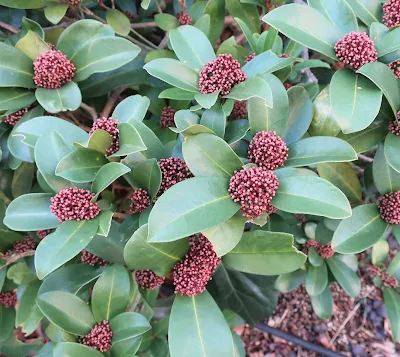
Skimmia Japonica (Japanese Skimmia) 深山樒(ミヤマシキミ)

Japanese follows English. 英語の後に日本語が続きます。

These are the flower buds of skimmia japonica or more commonly known as Japanese skimmia. These buds open to tiny fragrant white flowers in March to May, but the leaves and fruits are toxic (containing alkaloids), and this is suggested in the name "skimmia." The term "skimmia" is derived from the Japanese words "ashiki mi," which means "bad fruit."

But the plant has another name "oku ryou" in Japan, meaning 100,000,000 ryou because the fruits are bigger than those of ardisia crenata (Christmas berry), which is called "man ryou" or "10,000 ryou." Ryou is a unit of weight and currency used in Japan and other Asian countries.   

Skimmia japonica 深山樒

Japanese skimmia ミヤマシキミ

Edgeworthia Chrysantha (Oriental Paperbush) 三椏(ミツマタ)

Japanese follows English. 英語の後に日本語が続きます。

These are the flower buds of edgeworthia chrysantha or more commonly known as oriental paperbush. The plant is a kigo for early spring. Kigo is a word or phrase associated with a particular season used in traditional forms of Japanese poetry, such as haiku. So for me, oriental paperbush buds always herald the arrival of spring (although it's coldest in January and February in Japan). 

The plant is used to make Japanese paper and bank notes. Because of its importance, oriental paperbush is depreciated over five years as a depreciable asset under Japanese corporate tax law😊.  

Edgeworthia chrysantha 三椏

Kuromame (Sweetened Black Soybeans for New Year) 黒豆(クロマメ)

Japanese follows English. 英語の後に日本語が続きます。

Japanese people eat osechi dishes at New Year. Osechi dishes are are traditional Japanese New Year foods consisting of a variety of dishes including the following:
  • Datemaki, sweet rolled omelet mixed with mashed shrimp. It symbolizes scholarship and culture.
  • Kamaboko, broiled fish cake. It symbolizes the rising sun.
  • Kazunoko, marinated herring roe, symbolizing a wish for an abundant harvest and fertility. Kazu means "number" and ko means "child."
  • Kobumaki, sweet soy-flavored rolled kobu (kelp) stuffed with a piece of salmon. It's associated with the word yorokobu, meaning "joy."
  • Tazukuri, dried sardines cooked in soy sauce. It literally means "rice paddy maker," symbolizing a bountiful harvest.
  • Zouni, a soup of mochi rice cakes in clear or miso broth.
  • Nishime, various vegetables (e.g., Japanese taro, carrot, burdock, lotus root, kelp, shiitake mushroom) simmered in clear broth.  
  • Kuromame, black soybeans simmered in sweet and savory sauce, symbolizing a wish for health. Mame means "health." 
This year I made the last three, i.e., zouni, nishime and kuromame, and I took pictures of kuromame because the black color of the beans is so beautiful and it took two days to make it, i.e., one day to soak black beans in water and seven hours to simmer them! But of course, it was worth it!

Many Japanese people make resolutions at New Year. My resolution this year is to make roast beef and apple pie (using a store bought pie crust though)! 

Kuromame, black soybeans simmered in sweet and savory sauce 黒豆

Common Bluebottle (Graphium Sarpedon) アオスジアゲハ(青条揚羽)

英語の後に日本語が続きます。 Their blue always cheers me up. The common bluebottle (Graphium sarpedon) is native to East and Southeast Asia, as well as Au...