Yuki Tsuri - Japanese Way to Protect Trees from Snow 雪吊り(ゆきつり)

Japanese follows English. 英語の後に日本語が続きます。

These cone shaped things are "yuki tsuri" at the Hama Rikyu Garden. Yuki tsuri is a Japanese technique to protect trees from heavy snow with straw ropes that are attached to the ends of the tree's longer branches. The technique is commonly seen in the Hokuriku region where it heavily snows, such as Kanazawa city, while in Tokyo where it rarely snows, yuki tsuri functions more as a seasonal decoration. The yuki tsuri, the blue sky and the skyscrapers created a surreal contrast. 

The Hama Rikyu Garden, about 62 acres, was built by Tsunashige Tokugawa in 1654 on reclaimed land from Tokyo Bay. The garden was transferred to the Imperial Household Agency in 1870, then to Tokyo in 1945 and opened as a public garden in the following year. You can always enjoy some flowers/plants from cherry blossoms to autumn foliage in the garden.

Yuki tsuri to protect trees from snow 雪吊り

Prunus Mume cv. Yae Kanko 八重寒紅(ヤエカンコウ)

Japanese follows English. 英語の後に日本語が続きます。

These are the flowers of prunus mume cv. "yae kanko" at the Hama Rikyu Garden. It's been a long time since I last saw such colorful flowers.

The flowers are often used for New Year decorations in Japan because they're gorgeous, i.e., double flowered and bright pink, and bloom from mid December to mid January, earlier than other prunus mume, which generally bloom from late January to late April.

The Hama Rikyu Garden, about 62 acres, was built by Tsunashige Tokugawa in 1654 on reclaimed land from Tokyo Bay. The garden was transferred to the Imperial Household Agency in 1870, then to Tokyo in 1945 and opened as a public garden in the following year. You can always enjoy some flowers/plants from cherry blossoms to autumn foliage in the garden. 

Prunus mume cv. yae kanko 八重寒紅

Skimmia Japonica (Japanese Skimmia) 深山樒(ミヤマシキミ)

Japanese follows English. 英語の後に日本語が続きます。

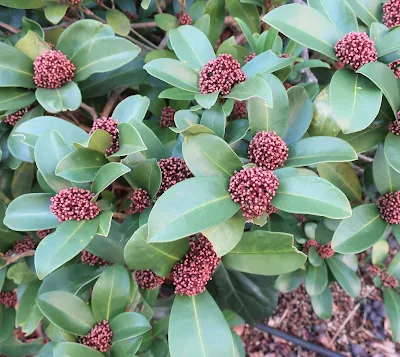
These are the flower buds of skimmia japonica or more commonly known as Japanese skimmia. These buds open to tiny fragrant white flowers in March to May, but the leaves and fruits are toxic (containing alkaloids), and this is suggested in the name "skimmia." The term "skimmia" is derived from the Japanese words "ashiki mi," which means "bad fruit."

But the plant has another name "oku ryou" in Japan, meaning 100,000,000 ryou because the fruits are bigger than those of ardisia crenata (Christmas berry), which is called "man ryou" or "10,000 ryou." Ryou is a unit of weight and currency used in Japan and other Asian countries.   

Skimmia japonica 深山樒

Japanese skimmia ミヤマシキミ

Blood Type and Personality in Japan 血液型と性格

英語の後に日本語が続きます。

Japanese people often guess others' personalities based on their blood type. In Japan, many believe that each blood type carries specific traits:
  • A: Down-to-earth and careful
  • B: Independent and curious
  • O: Positive and sociable
  • AB: Rational but multifaceted
Hearing people talk about blood types always reminds me of a professor in the social psychology department at my university.

2022 is the Year of the Tiger🐯! - Japanese Zodiac Signs 来年は寅年だ🐯!

英語の後に日本語が続きます。

These are trees made of stuffed tiger animals currently on show at the Tokyo International Forum. Every December, the facility displays trees made of stuffed animals representing the zodiac sign of the coming year. This year, it has three tiger trees because 2022 is the Year of the Tiger🐯!!

Ardisia Crenata F. Leucocarpa (White Coral Berry) 白実の万両(シロミノマンリョウ)

英語の後に日本語が続きます。

These photos show Ardisia crenata f. leucocarpa, more commonly known as white coral berry.

I found them when they were still bright green in early August (4th photo), and I watched them turn from green to creamy white over the next four months, believing they would ultimately turn red—until a few days ago, when I learned that some coral berries actually produce white ones!! 😂😆

12/26/2021

Camellia Sinensis (Tea Plant) 茶の木(アッサムチャ)

英語の後に日本語が続きます。

These adorable white flowers, about 2 cm in diameter, caught my eye. They are Camellia sinensis, commonly known as the 'tea plant,' which I saw at the Koishikawa Botanical Garden in Tokyo. The tea plant belongs to the camellia genus, and I was surprised by how small a camellia flower could be.

Camellia sinensis 茶の木

Halesia Carolina (Carolina Silverbell) 亜米利加麻殻(アメリカアサガラ)

英語の後に日本語が続きます。

The four-winged brown things hanging from the trees first caught my eye. These are the fruit—or seed pods—of Halesia carolina, more commonly known as the Carolina silverbell or little silverbell, at the Koishikawa Botanical Garden in Tokyo.

Halesia Carolina 亜米利加麻殻

Diospyros Rhombifolia (Princess Persimmon) 老鴉柿(ロウヤガキ)

英語の後に日本語が続きます。

These are princess persimmons (Diospyros rhombifolia) at the Koishikawa Botanical Garden, Tokyo. The tree was side by side with a Cathay persimmon tree (Diospyros cathayensis Steward). Both persimmons resemble each other but there's a difference - the princess persimmon is deciduous while the Cathay persimmon is evergreen. (Take a look at the second picture!)

Diospyros rhombifolia 老鴉柿(ロウヤガキ)

Japanese Maple Autumn Leaves 楓の紅葉(カエデ)

英語の後に日本語が続きます。

These photos show autumn Japanese maple leaves at the Koishikawa Botanical Garden in Tokyo. As the fall foliage season was almost over, I thought autumn leaves had mostly fallen. So, it was a happy surprise to see many trees still showing such beautiful yellow, orange and red leaves against the blue sky! The trees at the garden are all large, so I was able to take many pictures of these leaves from below (in the first three photos).

From below

Diospyros Cathayensis Steward (Cathay Persimmon) 四川常盤柿(シセントキワガキ)

英語の後に日本語が続きます。

These are Cathay persimmons (Diospyros cathayensis Steward) at the Koishikawa Botanical Garden. 

At first, I thought they were kumquats, but they weren't. They're almost the same size, though the color and skin texture are different. Then I realized they were persimmons! They're mini, sweet, and totally edible 😊.

Diospyros cathayensis steward; 2 cm in diameter 直径2センチぐらいの四川常盤柿

Firethorn Tree (Pyracantha) ピラカンサ(常盤山査子)

英語の後に日本語が続きます。 Native to an area extending from Southwest Europe east to Southeast Asia, the firethorn, or pyracantha, can be found across J...